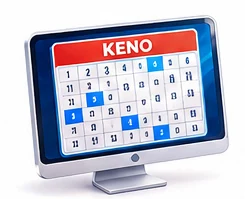
Keno looks straightforward on screen, but behind every draw is a probability calculation.
Understanding this does not provide a method for predicting winning numbers. It does, however, make it easier to understand why certain results pay much more than others and why apparently similar Keno games can have very different characteristics.
Every number has the same chance
Consider a classic game drawing 20 numbers from a pool of 80.
Before an independent random draw, no individual number is inherently "better" than another. The number 8 has the same chance of appearing as 37 or 72.
The same applies even if one number appeared several times in recent rounds while another has not appeared for a long time.
Past results do not force a random number to appear in the next independent draw.
Spots change the structure of the bet
The quantity of numbers selected is commonly described as the number of spots.
A 2-spot ticket and a 10-spot ticket are fundamentally different bets.
With more spots there are more possible levels of matching results, and the paytable has to account for the probability associated with each one.
This is why Keno prizes cannot sensibly be evaluated simply by asking how much the game pays for "five correct numbers". Five matches on a five-spot ticket and five matches on a ten-spot ticket represent different events.
Why rare outcomes pay more
A result becomes more difficult when it requires a greater degree of correspondence between your selection and the draw.
Paytables compensate by assigning larger prizes to certain less probable outcomes.
That does not necessarily mean that the biggest advertised prize offers the best overall value. The probability of reaching it also needs to be considered.
Understanding RTP
RTP means Return to Player.
It represents the theoretical proportion of wagers that a game is designed to return to players over a very large number of plays.
For example, a theoretical RTP of 95% does not mean that someone wagering €100 during one session should expect to finish with €95.
Individual sessions can differ enormously from the mathematical long-term average.
Why Keno RTP can vary
There is no single RTP applicable to every Keno game.
The return depends upon the rules and, especially, the paytable. Some games can even offer different theoretical returns depending on the number of spots or risk configuration selected.
This makes checking the information supplied for the individual game particularly important.
RTP and volatility are different
RTP describes theoretical long-term return. Volatility describes how that return tends to be distributed.
Two games could theoretically have comparable RTP figures while providing very different playing experiences.
One could produce relatively frequent smaller wins, while another concentrates a greater proportion of its payouts into uncommon high-value results.
The house edge
The house edge can be understood as the mathematical counterpart of RTP.
If a particular game has a theoretical RTP of 94%, its corresponding theoretical house advantage is 6%.
Again, this describes long-term mathematics rather than the result of a particular session.
Why the paytable deserves attention
When evaluating an online Keno game, do not stop at the maximum prize.
Check which results actually produce payouts and how those payouts change according to the number of spots selected.
The mathematics cannot tell you which numbers will appear next. It can tell you exactly what the game promises to pay when particular outcomes occur.
And that is much more useful than trying to predict a random draw.