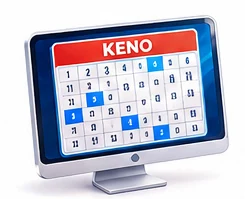
Moving Keno online did more than replace a paper ticket with a digital grid. Software developers gained the ability to modify the pace, presentation, paytables and even some of the fundamental parameters of the game.
As a result, "online Keno" now describes a family of games rather than one standardised product.
Classic Keno
Classic Keno attempts to reproduce the familiar casino format.
A typical game provides 80 numbers and draws 20 of them. Players select their spots before the draw and receive a prize when the resulting number of matches corresponds to a winning entry on the paytable.
Its strength is simplicity. There are few additional mechanics between placing a bet and discovering the result.
Video Keno
Video Keno applies the same general principles in a format designed for individual electronic play.
Instead of waiting for a central casino draw, the player can generally start a new round immediately.
Modern online Keno has inherited much of this structure.
Instant Keno
Online gambling makes extremely short Keno rounds possible.
Numbers can be generated and displayed within seconds, after which another ticket can immediately be created.
This changes the pace considerably. Faster games can mean considerably more money wagered over the same period of time, even when the individual stake remains unchanged.
The speed of a game should therefore be considered when setting a playing budget.
Multi-card Keno
Some games allow several Keno cards or selections to participate in the same draw.
Each ticket can contain a different selection of numbers.
Although this creates more opportunities for different combinations to match, each additional wager also increases the total amount staked. Playing several tickets does not transform the probability attached to an individual combination.
Keno with multipliers
Multipliers introduce an additional variable into the payout.
Depending on the rules, a qualifying prize might be multiplied by a randomly determined value or a special feature might activate enhanced payouts.
The important question is not simply whether a multiplier exists but how it affects the complete paytable and theoretical return.
Progressive Keno
Some Keno games include progressive jackpots.
Part of the betting activity can contribute to a prize pool that grows until the required winning condition occurs.
Large progressive prizes can be visually prominent, but they should not be considered separately from their probability of being won and the remainder of the paytable.
Adjustable-risk Keno
Certain modern games allow players to select a risk or difficulty level.
The terminology differs between developers, but the basic principle is often similar: changing the setting modifies the relationship between the frequency and size of potential payouts.
A higher-risk configuration may concentrate more of the game's return into less frequent but larger prizes.
Mobile Keno
Keno is particularly suited to smartphones because the basic interface requires little more than a number grid and a few controls.
A well-designed mobile version should nevertheless make essential information easily accessible, particularly:
- current stake;
- selected numbers;
- paytable;
- game rules;
- balance;
- previous result;
- responsible gambling controls.
Which version should you choose?
There is no universal answer.
Rather than concentrating on graphics or jackpot advertising alone, compare the underlying rules.
Look at the grid, number of drawn balls, available spot selections, paytable, RTP where published and pace of play.
Those characteristics tell you considerably more about a Keno game than its visual theme.