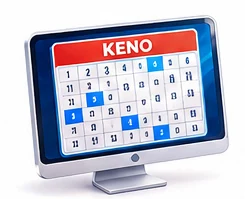
One reason Keno has survived through very different generations of gambling is the simplicity of its central idea. Unlike card games, there are no hands to memorise and no decisions to make once a round has started.
You select numbers. The game draws numbers. The number of matches determines whether the ticket wins according to the game's paytable.
The details surrounding this mechanism, however, can vary from one version to another.
Step 1: Understand the Keno grid
A traditional casino Keno game commonly uses 80 numbers, numbered from 1 to 80.
This format should not be treated as universal. Online developers can create Keno games with different grid sizes and rules, so the information panel and paytable should always be checked before wagering.
Step 2: Choose your numbers
The player selects a number of spots from the grid.
For example, a game might allow you to select between 1 and 10 numbers.
If you choose:
7 – 14 – 28 – 39 – 44
you are playing five spots.
The actual values selected are generally less important mathematically than the number of spots selected, because the number of spots determines which payout table applies.
Step 3: Choose the stake
After selecting the numbers, a wager is assigned to the ticket.
Online games may offer a fixed selection of stakes or allow the player to adjust the amount within minimum and maximum limits.
Increasing the stake can increase the potential monetary payout, but it also increases the amount exposed to loss. It does not make the selected numbers more likely to be drawn.
Step 4: Start the draw
Once the ticket has been confirmed, the game generates its winning numbers.
In the classic 80-number format, 20 numbers are typically drawn.
Online versions often animate the process by displaying numbered balls one after another, although the visual presentation does not alter the underlying result.
Step 5: Count your matches
The game compares the player's spots with the winning numbers.
Suppose you selected:
5 – 12 – 26 – 41 – 53 – 68
and four of these numbers appeared among the winning numbers.
You have achieved four matches on a six-spot ticket.
Whether that produces a prize, and how large that prize is, depends entirely on the paytable.
What is a Keno paytable?
The paytable is one of the most important parts of the game.
It specifies the prizes associated with every eligible outcome. Separate tables can apply depending on whether you play three spots, five spots, eight spots or another quantity.
It is therefore possible for two tickets with the same number of matches to produce completely different results if they started with different numbers of spots.
Quick Pick
Players do not normally have to select every number manually.
Most digital Keno games include an automatic selection feature commonly called Quick Pick, Auto Pick or a similar name.
The software randomly selects the required number of spots.
For a genuinely random draw, manually choosing numbers does not provide a probability advantage over randomly generated selections.
Can you change your numbers during a draw?
Normally, no.
Once the wager has been accepted and the round starts, the ticket is fixed. Changes can only be made before a subsequent round.
This is why Keno should primarily be understood as a game of probability rather than a game involving decisions during play.
Different rules mean different probabilities
Not every game called Keno uses the same configuration.
You may encounter:
- 80-number Keno;
- reduced grids;
- different quantities of drawn numbers;
- variable risk settings;
- progressive prizes;
- multipliers;
- bonus rounds;
- unusually large or small spot selections.
Consequently, learning the basic rules is only the first step. Always read the rules of the particular Keno version you intend to play.
Keno outcomes are random. No selection method can guarantee a winning ticket.